
I started with a question: What are the ten best ways I could use ChatGPT Work in my personal life?
Then I added a twist, inspired by watching a video from 9X. Their demo showed AI assistants working through a task together. Credit to them for getting me interested in trying this myself.
Rather than ask for another top-ten list, I asked ChatGPT Work to open Claude.ai in the connected browser and discuss the question with Claude. I wanted them to go back and forth, question each other’s suggestions, and settle on a useful list.
As the discussion unfolded, I started thinking about my other projects. Could I use the same approach to review a website plan? Work through a Home Assistant automation? Catch a weak assumption before spending time building something?
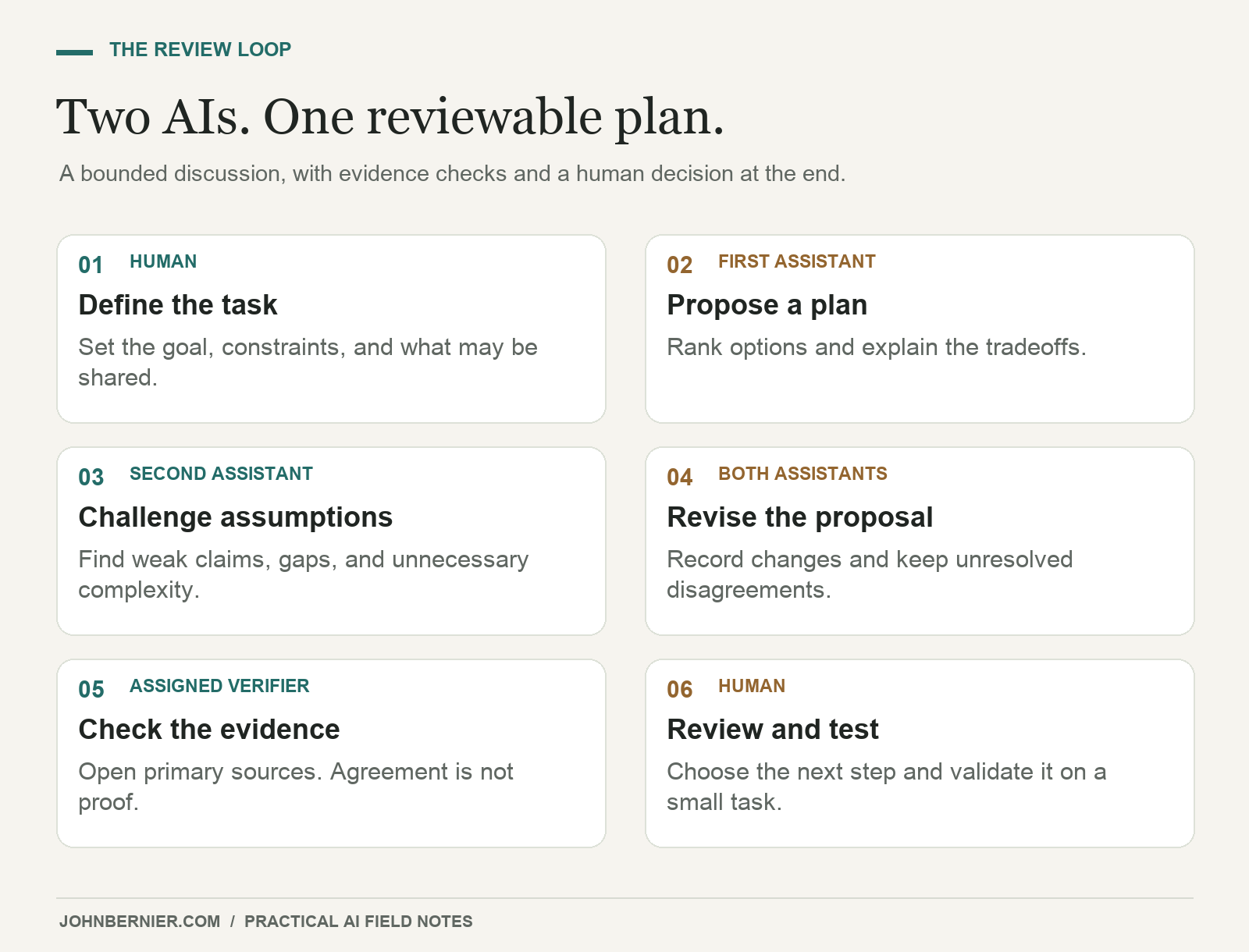
How the conversation worked
ChatGPT Work gave Claude a short description of my interests: home automation, YNAB budgeting, React and AI projects, my website, astronomy, technology, and productivity. No financial records, emails, or Home Assistant configuration files were sent to Claude.
Claude proposed the first ranking. ChatGPT Work challenged some of the choices and assumptions. Claude revised the list, explained its reasoning, and pushed back on a few points. One more round tightened the recommendations.
There were three rounds in total. ChatGPT Work typed messages into Claude’s browser interface and read the replies, much as I would if I were moving between the two tools myself. This was a browser conversation, not a dedicated integration between the services.
Where the answer changed
Claude’s first two recommendations were a monthly YNAB budget review and a Home Assistant configuration audit. Both stayed at the top. They made sense for my interests and would produce something I could check: budget calculations, or proposed configuration changes with test and rollback steps.
A few other suggestions needed more work.
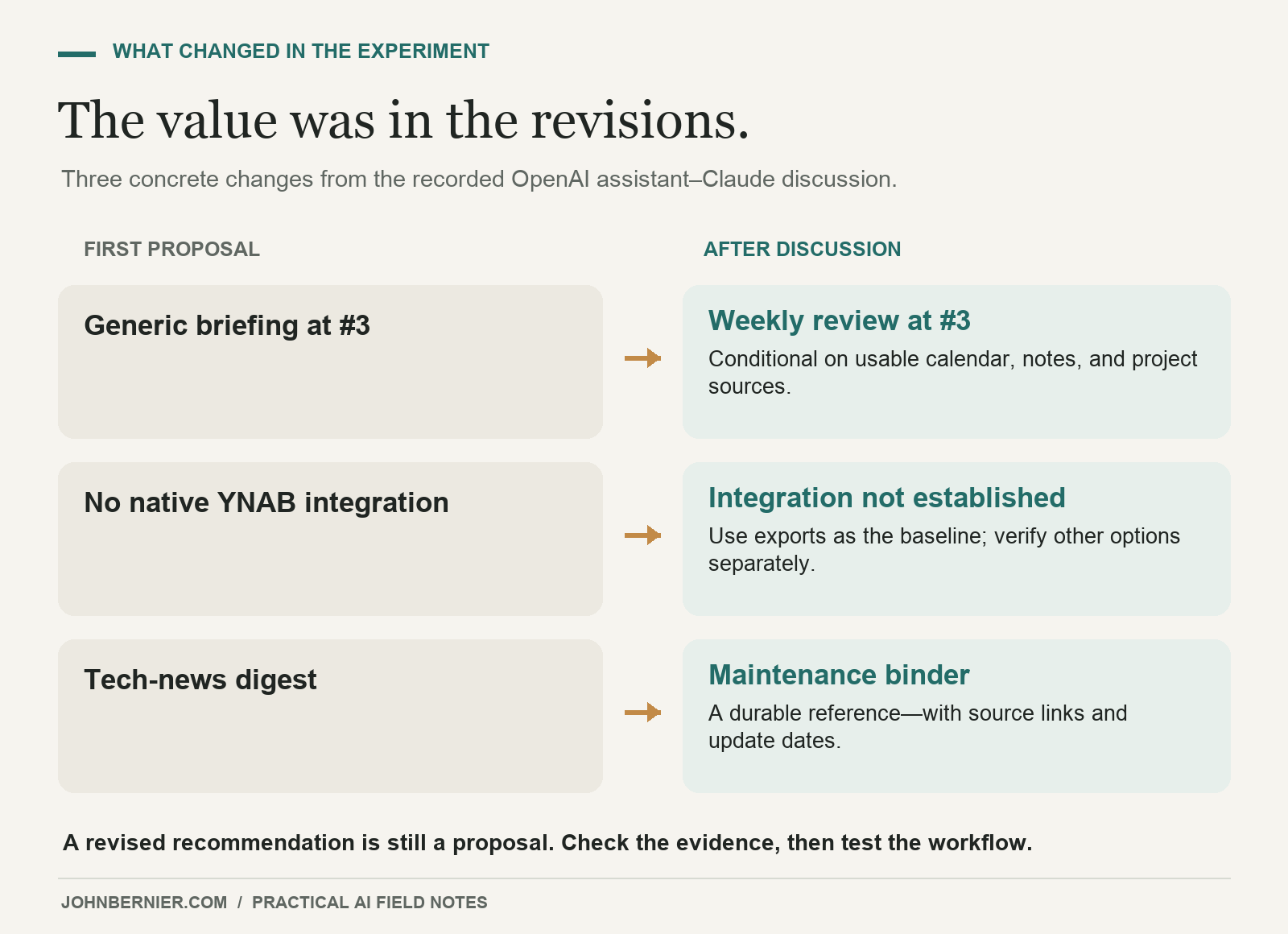
A news briefing gave way to weekly planning
Claude initially ranked an astronomy and technology briefing third. It also acknowledged that briefings are easy to ignore. ChatGPT Work questioned why a generic digest should rank above something that helped me plan my week.
The revised list moved a weekly review to third place. The idea was to pull together selected calendar commitments, notes, tasks, and project items, then suggest three priorities and realistic time blocks.
Claude kept a condition attached: the ranking only made sense if the necessary sources actually returned useful information. If the assistant couldn’t access those sources, the recommendation needed to move down the list.
That was a useful distinction. A weekly plan based on my actual commitments could help. A confident plan based on missing information would just give me something else to correct.
An integration claim needed correcting
Claude initially said there was no native YNAB integration. ChatGPT Work challenged that statement because it hadn’t been verified.
The recommendation changed to using exports as the starting point, with integration availability left as an open question. We hadn’t established whether a suitable integration existed.
It was a small correction, but exactly the kind I wanted this process to catch. An unverified claim could easily have shaped the rest of the plan.
A maintenance binder replaced another digest
In the final round, ChatGPT Work proposed replacing a tech-news digest with a home-tech maintenance binder. That would bring together selected manuals, troubleshooting guidance, maintenance checklists, and source links.
Claude accepted the idea but raised a practical concern: who keeps it current? A guide written for an old device version might cause more confusion than it solves.
By the end, the list had changed, and several recommendations had clearer requirements attached to them.
Where I want to try this next
I’m interested in using this before I get too far into a project.
For a React or AI build, one assistant could propose the approach while the other looks for unnecessary complexity, missing requirements, or gaps in the testing plan. I’d rather catch those questions before writing a lot of code.
For Home Assistant, I could give them a sanitized automation design and ask about conflicting triggers, failure conditions, and how to undo a change. I would still need to test it in my actual setup.
For my website, one could suggest content and navigation changes while the other asks whether those changes would help a visitor. It’s easy to keep adding pages. It’s harder to decide which ones are worth maintaining.
I wouldn’t bother with this for every small question. It adds steps, and there’s more output to read. I’d use it when I’m weighing a few reasonable approaches or making a decision that would take time to undo.
What I would watch out for
Two AIs agreeing doesn’t settle a question. They can share the same bad assumption, or one can accept the other’s argument too easily.
There was a clear example of the limits in this session. Claude said it had not opened the official OpenAI documentation. ChatGPT Work checked the sources and passed summaries into the discussion. That was one source check, not two independent checks.
We also didn’t compare this process against a single assistant working on the same task. I can point to the revisions, but I can’t claim we proved better performance or saved a measured amount of time. And we haven’t run the workflows on the final list yet.
Next time, I’d ask them to preserve any disagreements instead of treating agreement as the finish line. I’d also give the discussion a limit. More rounds won’t help if they’re just restating the same points.
If you want to try it
Start with a small planning task and share only the context needed to review it. For this experiment, a description of my interests was enough. Claude didn’t need my budget or access to my smart home.
Here’s the kind of instruction I’d use next time:
Help me plan [task]. Ask a second AI to review the proposal for weak assumptions, missing constraints, and unnecessary complexity. Share only the context needed. Use up to three rounds, stopping earlier if there’s nothing useful left to resolve. Check current product claims against official sources. Show me what changed, why it changed, and where you still disagree. Return the plan for review before taking action.
You’ll need the appropriate browser access, a signed-in session where required, and tools available in your account. OpenAI documents both ChatGPT Work and browser use. This experiment doesn’t establish a dedicated connection to Claude, YNAB, or Home Assistant.
My next step is to try one of the recommendations on a real task: a month of YNAB exports, a small Home Assistant audit, or a weekly planning review.
Then I can ask a more useful question: Did the discussion help me get something done?