
Lately, opening an AI application has started to feel like walking into a room where someone keeps rearranging the furniture.
Something looks different. A familiar option has moved. There is a new name to understand or another place to start. Before I can get back to what I was doing, I have to figure out how the room works again.
I use AI because I see its value. I want to explore it, build useful things with it, and help other people use it. But I keep coming back to the same question: if this technology is supposed to make life simpler, why does using it sometimes feel more complicated?
More capability does not automatically mean a better experience
Agents. Skills. Projects. Modes. Plugins.
There are reasons for these distinctions. A reusable set of instructions serves a different purpose from a connection to your email. A tool that can take action needs different controls from one that simply answers a question.
But those distinctions create a design responsibility. The company understands how the pieces fit together. How much of that understanding should the customer need just to get something done?
I want to write an article, build a small application, analyze a report, or improve a prompt. I should be able to explain that outcome and get useful help. Instead, I sometimes find myself working out where the task belongs before I can begin.
That is my frustration with the direction of the experience. Adding features can make a product more capable while making the path through it harder to follow. Both can happen at the same time.
A prompt generator should be a simple example
I already have a working Gemini Gem called Work Smarter Not Harder, built around the TCREI framework for creating and refining prompts. When I explored offering the same tool through ChatGPT, the conversation moved from a standalone app and ongoing API costs to a custom GPT, then to plugins and questions about sharing. I wanted to give people a useful prompt generator, without having to charge them to cover an app’s running costs.
My AI thought partner (the one of us who doesn’t need coffee) and I spent that voice chat navigating platform choices just to reproduce something that already worked. OpenAI’s Enterprise migration guidance does describe moving custom GPT workflows to plugins, but notes that timelines and public sharing for other plans may differ. It leaves questions about the right choice for my tool—and illustrates how a modest goal can turn into a conversation about the platform’s architecture.
Where Did Gemini Spark Go?
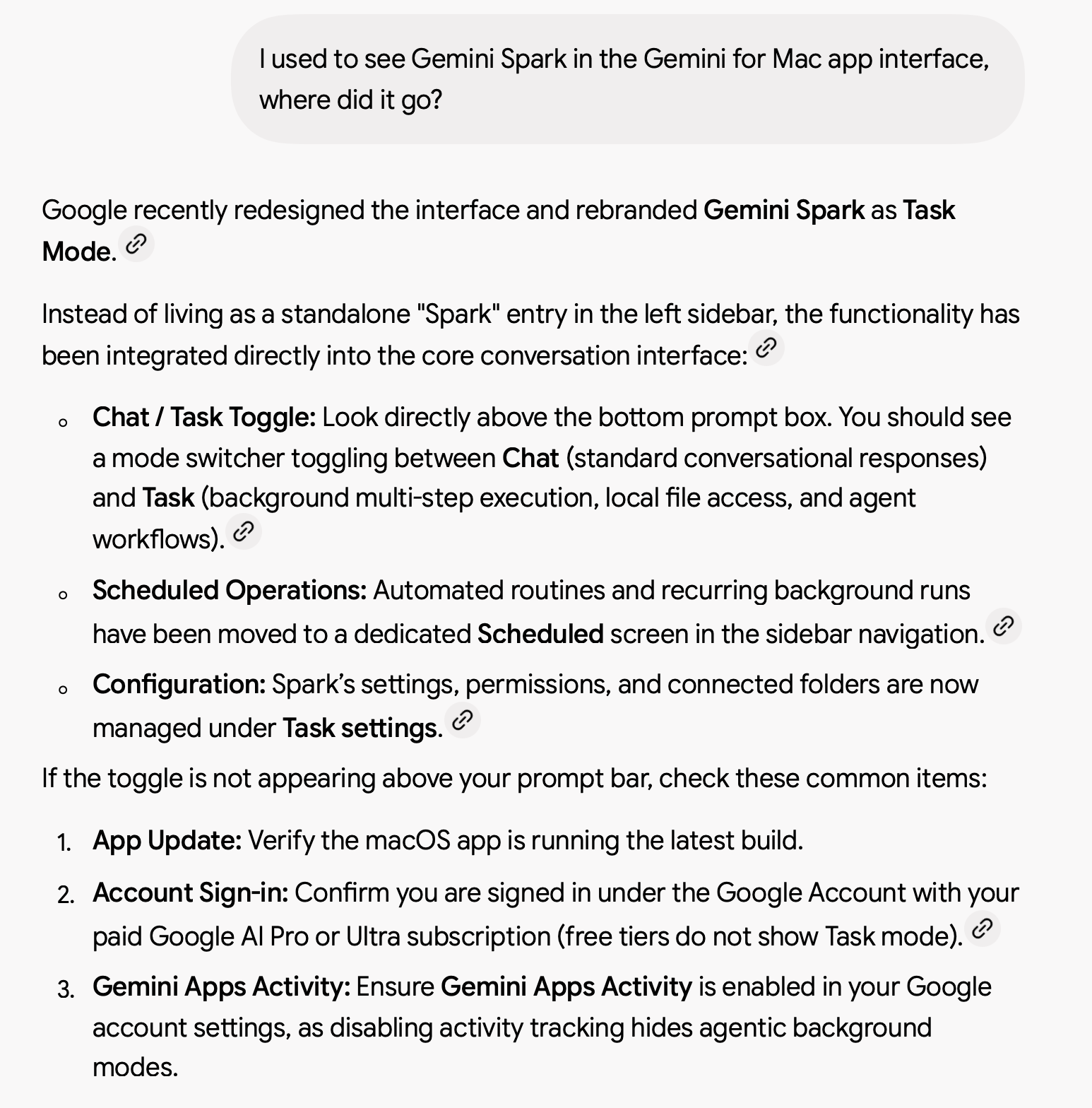
I ran into the same frustration in Gemini for Mac. I had been using Gemini Spark, then could no longer find the familiar entry in the interface. I ended up asking Gemini itself: “I used to see Gemini Spark in the Gemini for Mac app interface, where did it go?” Its reply described a move to “Task Mode,” followed by directions for finding controls and checking settings. The product design had changed, and I was left figuring out how to continue. Before I could return to my work, I had to ask where my tool had gone.
Google’s October 13 app announcement describes accessing tasks through a toggle in the main chat window. The aim may be a simpler experience, but getting used to the new design still took effort on my side.
The cost is the attention it takes
A moved button is a small inconvenience. Repeatedly having to relearn where things belong is a larger one.
There is the time spent finding the right starting point. There is the uncertainty about whether familiar instructions still apply. And there is the hesitation before investing effort in a workflow you may have to revisit when the product changes again.
I am describing my experience, not claiming that every user encounters the same problems or that every provider handles change the same way. Some changes make the experience better. Products need room to improve.
But consistency has value, too. When I know where to begin and what to expect, I can put my attention into the work. When I have to keep checking how the product is organized, the product itself becomes part of the job.
In an earlier post about AI and productivity, I argued that the time spent preparing, reviewing, and editing belongs in the calculation. So does the time spent learning how to use the tool again.
Someone needs to own the whole experience
My view is that someone needs to be responsible for the entire path from “here is what I need” to “here is a result I can use.”
A team can build an excellent feature and still leave people confused about when to use it. The handoff between features matters just as much as the features themselves.
I would like to see AI products start with the outcome. Let me describe the work. Help me choose the right approach when a choice matters. Keep that work together as I move from discussion to a document, a website, or another finished result.
The technical details can still be available for people who want them. Experienced users should have control. But learning the company’s vocabulary should not be the price of getting started.
And when something changes, help me carry my work forward. Explain what moved, what still works, and what I actually need to do. A release announcement is useful; continuity for an existing workflow is more useful.
Google’s Gemini at Work 2026 event on October 8 pointed in this direction. In its keynote announcement, Google described a single agent and interface for asking questions, assigning work, and generating code. To me, that suggests an effort to make the experience simpler and more connected. It remains to be seen how well that vision will work in everyday use—and whether the other major AI companies will follow through with similarly consistent experiences.
Make the useful path easier to follow
I do not expect AI to make every decision for me. I still need to review facts, judge the quality of the work, and decide what I am comfortable sharing or allowing a tool to do.
Those are decisions worth my attention. Working out which doorway leads to the same task I completed last week is a different matter.
I want these products to succeed because I know how useful they can be. That is why I think the experience deserves as much attention as the next capability.
When I return to an AI tool, I want to pick up my work with confidence. I want the product to make it easier to move from an idea to something finished.
That is the kind of progress I would like to see more of.