
I recently asked AI to help me review my week.
The request was simple: look across the work I had been doing, identify a few themes, and draft a short status update. It did something useful almost immediately. It surfaced a meeting, a few threads about my website and practical AI work, and a next step that had been sitting in the background: turn one of those ideas into something published.
That was a good start. It was not a conclusion.
The review could tell me what it could see. It could not tell me which part of the week had the most weight, whether a promising idea was actually worth pursuing, or what I had the energy and attention to carry forward. Those are not missing data points. They are judgments.
AI can gather the record. It cannot live the week.
There is real value in asking AI to collect the raw material for a review. Most weeks leave a trail: calendar events, project notes, conversations, documents, and unfinished tasks. Pulling that together is exactly the kind of administrative work that can make reflection feel harder than it should.
An AI assistant can help reduce that friction. It can organize a list, point out recurring topics, and turn a scattered record into a readable first draft.
But a record is not the same thing as meaning.
The calendar may show a meeting. It does not know whether that meeting changed how I should approach next week. A draft may show up in a project folder. It does not know whether the idea is ready, whether it belongs to the right audience, or whether I am avoiding a more important task by polishing it.
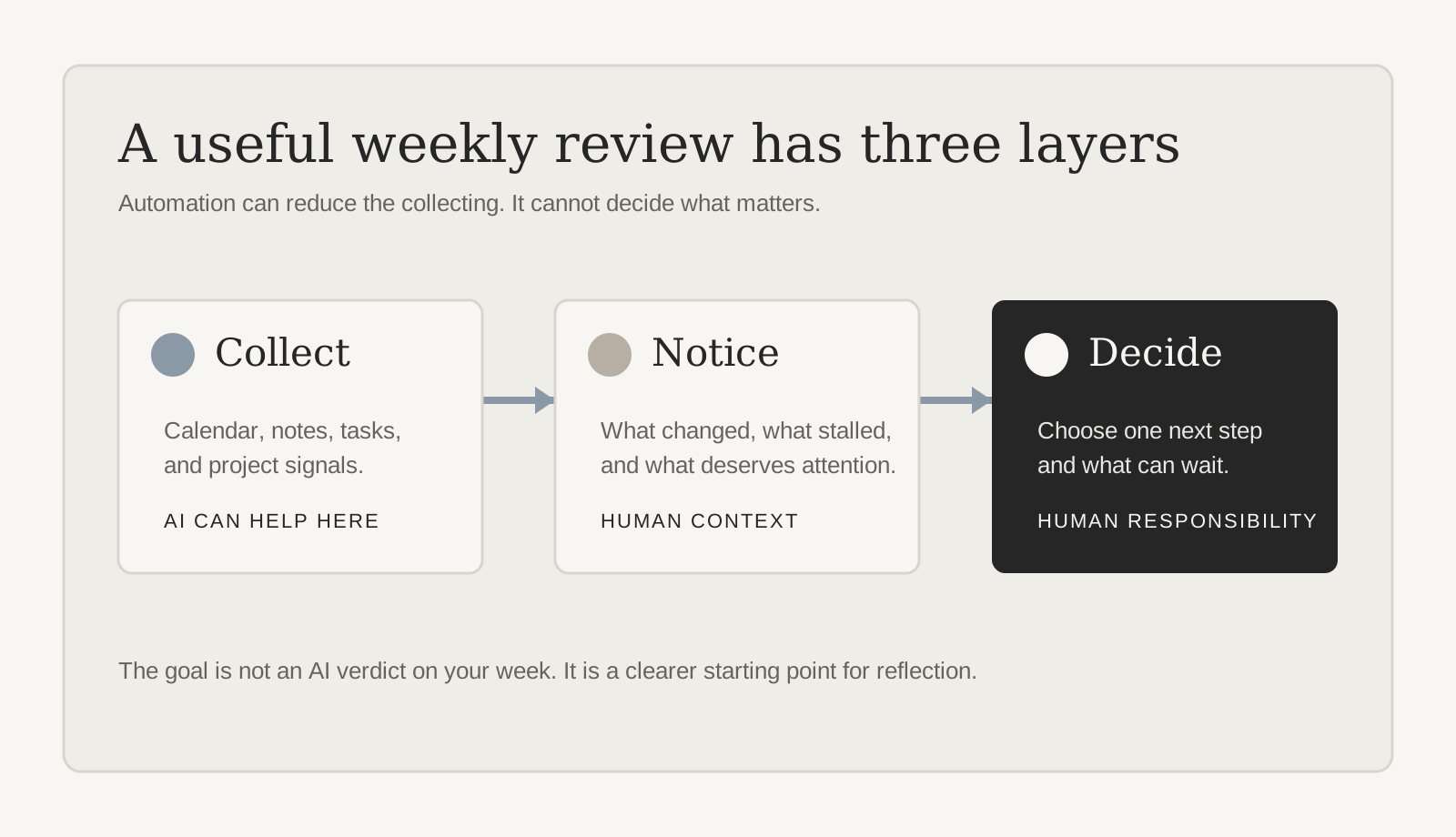
The distinction matters because an AI-generated summary can sound complete even when it is only an inventory. If I treat that inventory as a verdict, I have quietly handed over the most important part of the process.
What the summary missed
The first weekly-review draft gave me a sensible suggestion: publish one website improvement and capture the result. That is a reasonable next step. My site is where I share the projects, experiments, and observations I want people to find.
Still, I needed to ask questions the draft could not answer for me:
- Is a new blog post the most meaningful use of my next available block of focused time?
- Which idea would add something new to the site instead of repeating a point I have already made?
- What would “done” actually mean: a draft, a published article, or a post supported by visuals and a clear distribution plan?
- What should I deliberately leave alone this week?
Those questions turn a generic recommendation into a decision.
For me, the answer was to write about the review itself. It connects to the practical AI themes I have been exploring, but it also gives the idea a limit: AI can prepare the review; I am responsible for deciding what happens next.
The checkpoint is the feature
The most useful part of an AI workflow may be the moment when it stops.
I think of that moment as a decision checkpoint. The assistant gathers a small set of signals and drafts a summary. Then I review it before anything becomes a commitment. I can challenge an assumption, add context that was not available in the sources, lower the scope, or decide that the apparent priority is not actually the right one.
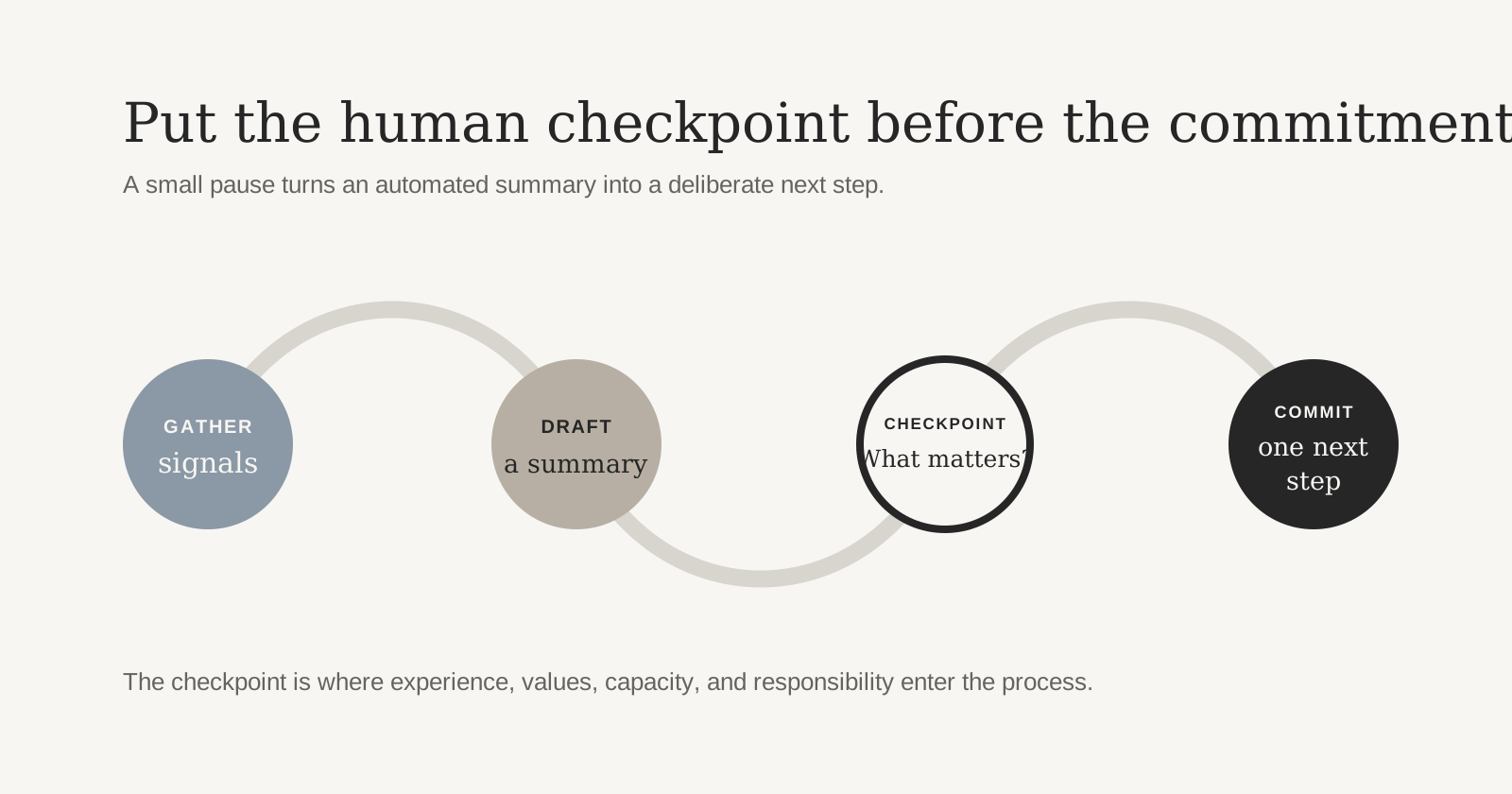
This does not need to become an elaborate ritual. A few minutes is enough if the question is clear:
Based on this summary, what is one next step I am willing to make real—and what am I choosing not to do yet?
That question keeps the AI in a helpful role. It helps me see the field. It does not choose the direction.
A lightweight weekly review I would reuse
Here is the version I would keep using:
- Collect a bounded set of sources. A calendar, selected project notes, and a task list are enough. More data is not automatically a better review.
- Ask for a brief draft, not a performance score. I want themes, open loops, and possible next steps—not a confident judgment about whether the week was “productive.”
- Add the missing context. What felt important? What changed? What constraint matters next week that the sources cannot show?
- Choose one commitment. Make it small enough to be real and specific enough to recognize when it is finished.
- Keep the evidence. A short note about what I chose and why makes the next review more useful.
The point is not to turn every week into a quantified system. It is to remove enough of the administrative burden that I can spend my attention where it matters.
Let AI prepare the question, not answer it
I am interested in AI systems that reduce repetitive work without quietly taking over decisions that deserve care. A weekly review is a good test case.
The assistant can gather the record and draft the first pass. It can make a forgotten thread visible and help me notice a theme. That is valuable.
But the week still belongs to the person who lived it.
The next step should, too.