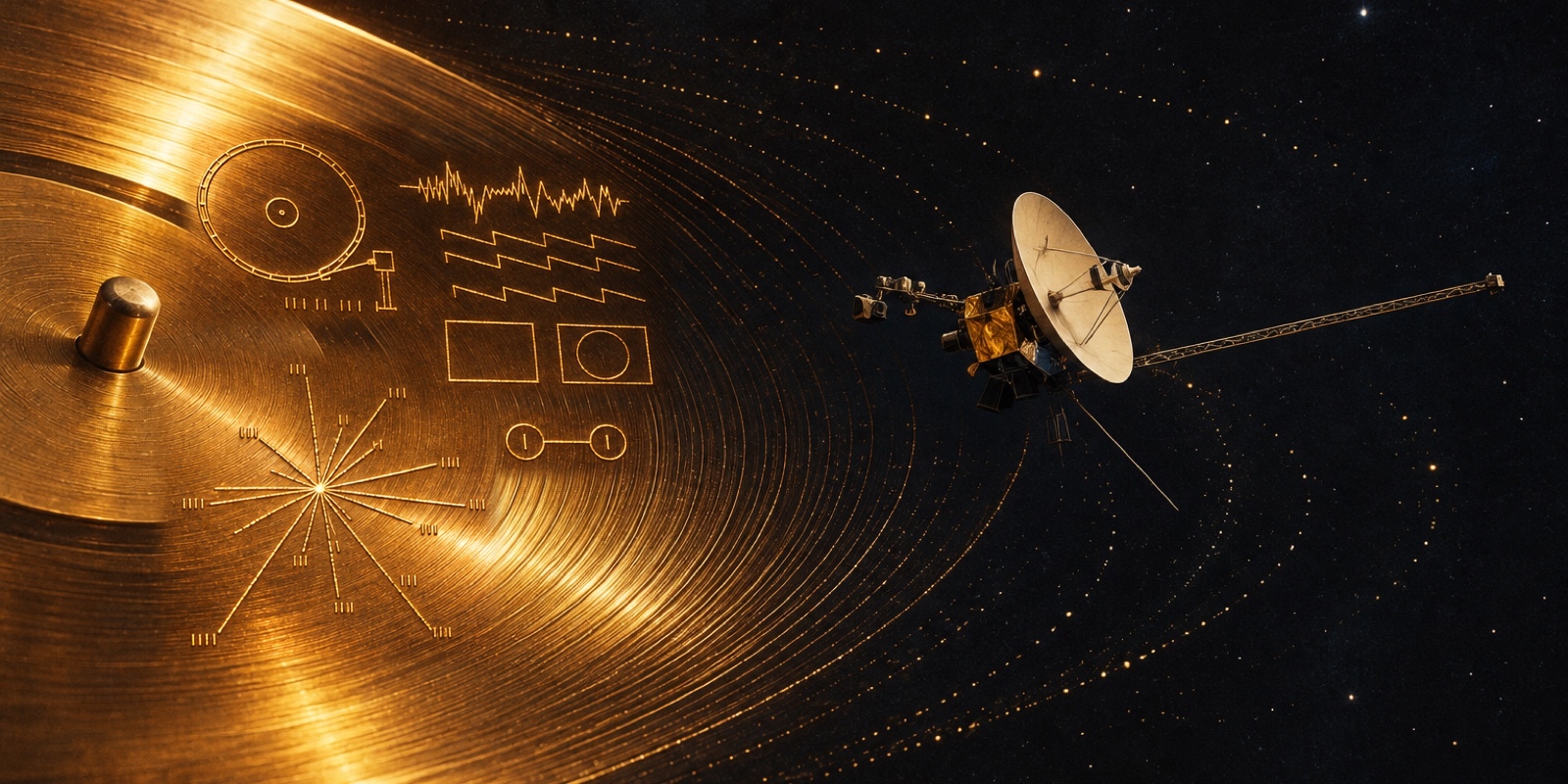
When I heard that Voyager 1 was one light-day away, my first thought was how far that must be. Then I thought about how long it had been traveling. Almost fifty years. And light could cover the same distance in a day.
On November 18, 2026, Voyager 1 became the first spacecraft to reach one light-day from Earth. It launched in 1977. Its twin, Voyager 2, is also in interstellar space and is closer to us. One light-day is about 16.1 billion miles. At that distance, a radio signal we sent on Monday morning would arrive on Tuesday morning. Even if Voyager could answer immediately, we’d hear back around Wednesday morning. NASA’s milestone announcement
I’m impressed that there’s a machine we built in 1977 out there at all. I’m still getting my head around how close it is.
How far is the next star?
Proxima Centauri, the closest star to our Sun, is a little over four light-years away. Imagine covering that distance at Voyager 1’s current speed of about 38,000 miles per hour. It would take roughly 75,000 years. That’s for the nearest star. Light itself takes about 100,000 years to cross the Milky Way, and the Milky Way is one galaxy among billions. NASA’s guide to light-years
I can read a number like 75,000 years and move on to the next sentence. It’s harder to sit with what it would mean to start a journey knowing that every person who saw you leave, and many generations of their descendants, would live their entire lives while you were still on the way.
That also makes me wonder how long the trip would feel if we could travel close to the speed of light. According to Einstein’s special relativity, if a spacecraft could cruise to Proxima Centauri at 99% of the speed of light, about 4.3 years would pass as measured from Earth. The travelers would experience about seven months aboard the ship, assuming we leave out the time spent speeding up and slowing down. To them, a second would still feel like a second.
The part of Brian Cox’s example I keep thinking about is coming home. He imagines traveling so close to the speed of light that even a trip to the Andromeda galaxy could feel brief to the travelers. By the time they got back, millions of years would have passed on Earth. Everyone they’d wanted to tell about the trip would be long gone.
I usually think of better technology as a way to make a hard problem manageable. There’s a part of me that expects us to keep doing that until even the stars are within reach. Voyager gives me a sense of how much is packed into that assumption. It took generations of people to build these spacecraft and keep listening for them. I wonder what it would take to start something that nobody alive could see through, and to trust that the people who came after us would still think it was worth doing.
What would a stranger hear?
Both Voyagers carry a Golden Record. Among the things we chose to put on it were greetings in 55 languages, music, pictures, and the sounds of surf, thunder, and whales. The records even came with illustrated instructions for playing them. I love that a group of people had to sit down and think about how to explain a record player to someone who had never heard of Earth. NASA’s guide to the Golden Record
I’m used to thinking about first contact the way it happens in Star Trek. Someone says hello, and someone else is there to answer. If another civilization ever finds a Voyager and figures out how to play the record, the introduction could be very different. They might hear a wave breaking on a beach before they have any idea what an ocean is.
By then, there could still be people on Earth who would be astonished to learn the message had arrived. Our descendants might live somewhere else. There might be nobody left to hear about it. I find it strange and moving that a sound as ordinary as surf could outlast everyone who ever stood on that particular shore.
What I hope they’d find here
Does being so small in the universe make us less important? I don’t think so. I think about how much people have managed to learn from this one place. We figured out how to send a spacecraft beyond the bubble carved out by the Sun, and we keep finding ways to listen to it as it gets farther away. Then, with a little room aboard, we thought a stranger might like to hear what the world sounds like.
When I think about humanity’s place in all that space, I keep coming back to Earth. Seen from far enough away, the whole planet fits in a dot.
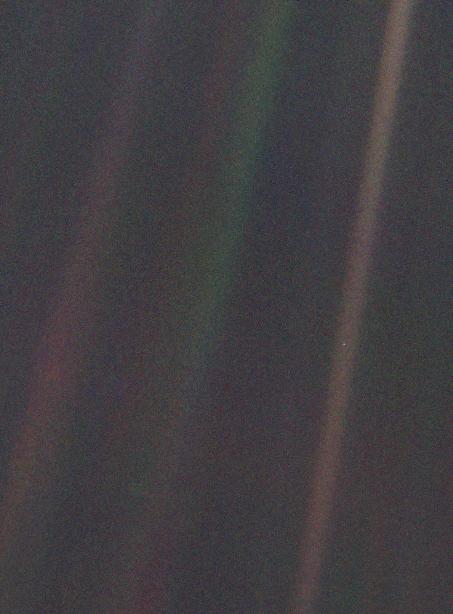 This is us,
this is everyone and everything
From here, it’s where every person I’ve ever known has lived, where those 55 languages were spoken, and where someone went out and recorded the sound of the sea. Earth is the only place we know of where there’s life. That makes me curious about what else might be out there, and it makes me want to take better care of what we already have here.
A wave breaking on the beach barely merits a second thought when I hear it. To a stranger, it might be the first evidence of a world with oceans. I wonder what else I’d put on the record if it were up to me. There are people and places I pass every day that I’d struggle to explain to someone who had never been here. I’d probably have to start by paying closer attention myself.
I hope someone finds one of the Voyagers someday. I hope they’re friendly, of course. And I hope that, if they ever make it to the place those voices came from, there are still people here who can take them down to the water and let them hear it for themselves.